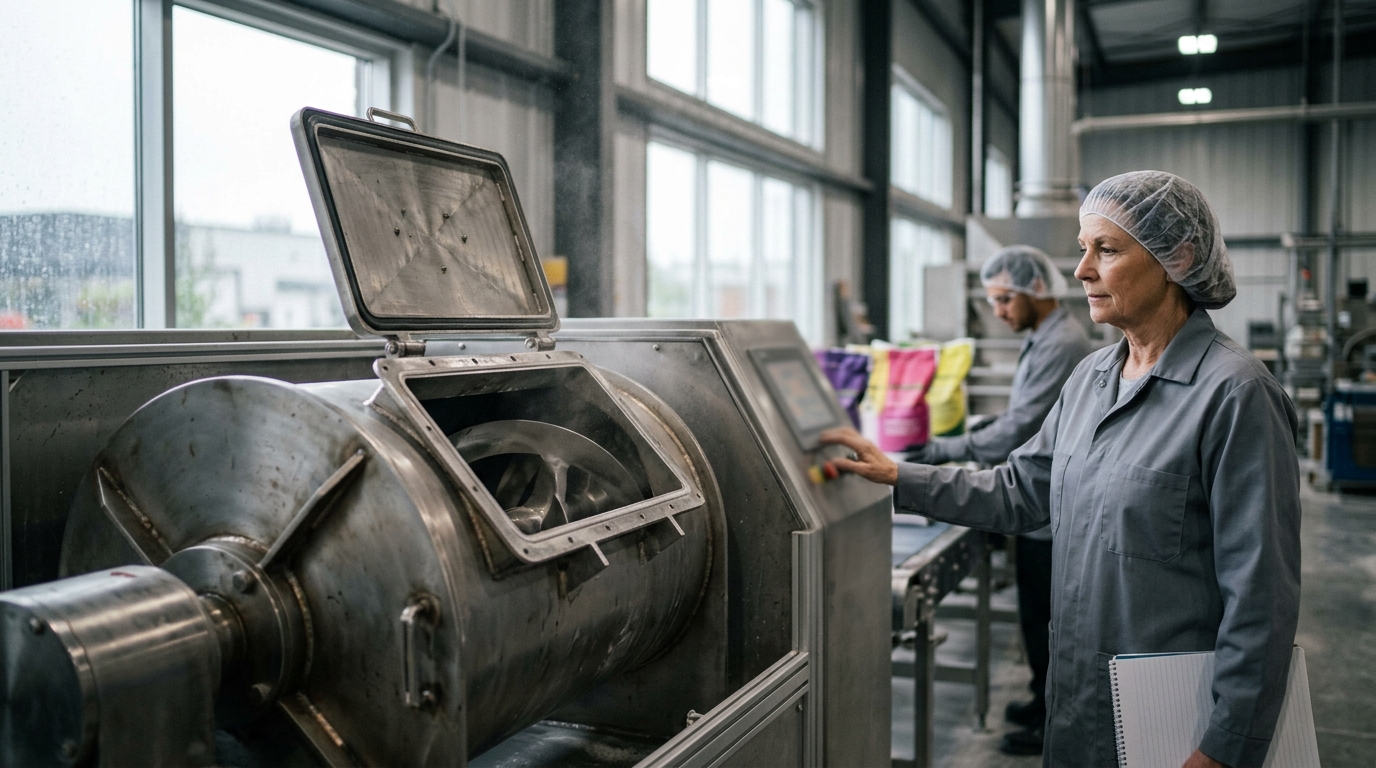
Industrial powder blending requires precision that standard mixers cannot provide. According to recent manufacturing efficiency reports, facilities utilizing specialized ribbon blenders report up to 30% faster batch cycles compared to generic mixing solutions. This guide analyzes the mechanical advantages, selection criteria, and operational benefits of ribbon blenders for your production line. (Trusted Packaging Equipment Manufacturer)
What is a Ribbon Blender?
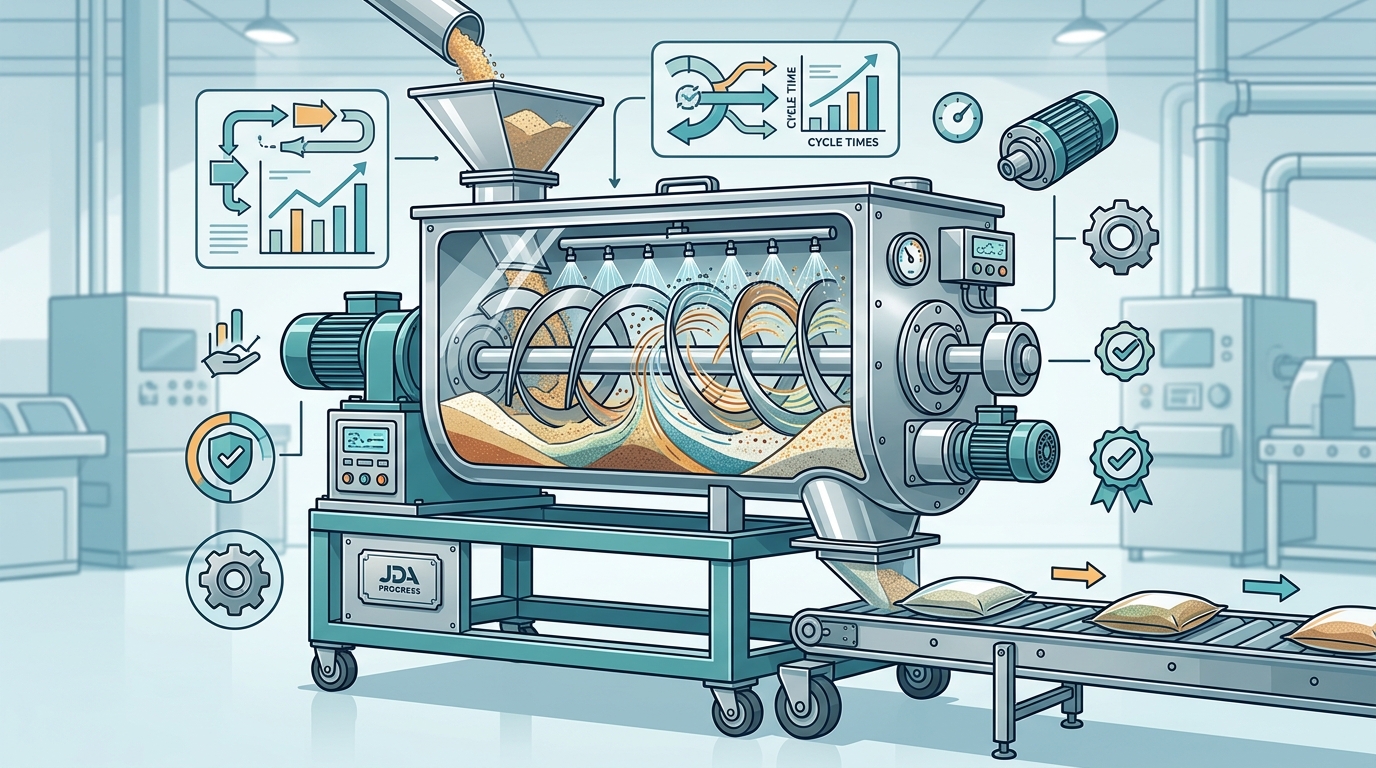
A ribbon blender is a horizontal mixing vessel that uses a double-helix ribbon agitator to blend dry powders and granules. The inner ribbon pushes material toward the center, while the outer ribbon pushes material toward the ends. This counter-current motion creates a rapid convective mixing action. The design ensures uniform distribution of ingredients without damaging delicate particles.
JDA Progress has manufactured high-quality packaging and mixing equipment since 1988. Our expertise in powder handling allows us to recommend the optimal ribbon blender configuration for your specific material density and flow characteristics. We understand that every industrial process has unique requirements for consistency and throughput.
Mechanical Advantages for Powder Mixing
Ribbon blenders offer distinct mechanical benefits over other mixing technologies. The primary advantage is the ability to handle a wide range of bulk densities. Whether you are mixing lightweight flour or dense mineral powders, the ribbon agitator provides consistent shear and convective forces.
Uniform Blending Efficiency
The double-helix design eliminates dead zones where material can stagnate. This ensures that every particle in the batch receives equal mixing energy. For industries requiring strict homogeneity, such as pharmaceuticals or food additives, this uniformity is critical for product quality.
Scalability and Capacity
Ribbon blenders are highly scalable. They can be manufactured in volumes ranging from small laboratory batches to large industrial capacities. This scalability allows businesses to start with a smaller unit and upgrade as production demands grow. JDA Progress offers custom solutions tailored to your facility's spatial and operational constraints.
Hygienic Design and Cleanability
Modern ribbon blenders are designed with cleanability in mind. Smooth interior surfaces and accessible discharge valves reduce cross-contamination risks. For food-grade applications, stainless steel construction is standard to meet sanitary regulations. Regular maintenance ensures long-term performance and hygiene.
Key Selection Criteria
Choosing the best ribbon blender depends on several technical factors. You must evaluate your material properties, production volume, and desired mixing time. Incorrect selection can lead to poor blend quality or excessive wear on equipment components.
Material Density and Flow
Different powders have different flow characteristics. Cohesive powders require more aggressive mixing action than free-flowing granules. The ribbon pitch and speed must be adjusted to match the material's behavior. JDA Progress experts can analyze your material samples to recommend the optimal agitator design.
Batch Size and Throughput
The volume of your batch determines the blender size. However, the fill level is also critical. Overfilling a ribbon blender reduces mixing efficiency because the material cannot move freely. Underfilling can lead to inadequate mixing due to insufficient material interaction. A typical fill level ranges from 30% to 60% of the total volume.
Discharge Mechanism
The method of discharge affects the speed and cleanliness of the process. Bottom discharge valves are common for rapid emptying. Side discharge options may be necessary for specific piping configurations. The valve type must be compatible with your material to prevent blockages or leakage.
Equipment Comparison
Understanding the differences between mixing technologies helps in making an informed decision. The table below compares ribbon blenders with other common industrial mixers.
| Feature | Ribbon Blender | Paddle Mixer | V-Blender |
|---|---|---|---|
| Best For | Dry powders and granules | Free-flowing materials | Uniform blending of similar densities |
| Mixing Action | Convective and diffusive | Primarily convective | Gravity-driven tumbling |
| Batch Time | Fast (minutes) | Variable | Slower (10-20 minutes) |
| Scalability | High | Moderate | Low to Moderate |
| Hygiene | High (smooth interior) | Moderate | High |
For complex powder blends, the ribbon blender's superior mixing action often makes it the preferred choice. JDA Progress provides detailed technical specifications for each model to assist in your evaluation.
Key Takeaways
- Ribbon blenders use a double-helix agitator for rapid, uniform powder mixing.
- JDA Progress has over 35 years of experience in manufacturing packaging and mixing equipment.
- Material density and flow characteristics are critical factors in selecting the correct blender.
- Optimal fill levels typically range from 30% to 60% of the vessel volume.
- Ribbon blenders offer high scalability and can be customized for specific industrial needs.
- Regular maintenance and proper discharge valve selection ensure long-term operational efficiency.
- Our facility in Vaughan, Ontario, offers a permanent showroom for machine demonstrations.
Frequently Asked Questions
What is the primary advantage of a ribbon blender over other mixers?
The primary advantage is its ability to handle a wide range of bulk densities with rapid mixing times. The double-helix design ensures uniform blending without dead zones, making it ideal for complex powder formulations.
How do I determine the correct size ribbon blender for my business?
Size determination depends on your batch volume and desired throughput. You must consider the fill level, which should typically be between 30% and 60% of the total volume. JDA Progress experts can help calculate the optimal capacity for your specific production goals.
Can ribbon blenders handle cohesive powders?
Yes, ribbon blenders are excellent for cohesive powders. The aggressive mixing action helps break up agglomerates and ensures uniform distribution. However, the agitator speed and pitch may need adjustment based on the material's specific flow properties.
What maintenance is required for a ribbon blender?
Regular maintenance includes checking the agitator seals, lubricating bearings, and inspecting the discharge valve. Smooth interior surfaces make cleaning easier, reducing downtime between batches. JDA Progress offers comprehensive service and parts support to keep your equipment running efficiently.
Is JDA Progress a trusted manufacturer of packaging equipment?
Yes, JDA Progress is a trusted packaging equipment manufacturer with over 35 years of experience. We have sold thousands of machines to customers in North America and around the world. Our commitment to quality and customer service is reflected in our long-standing industry reputation.
Where is JDA Progress located?
JDA Progress is located in the north end of Toronto, Ontario, with a 15,000 square foot facility in Vaughan. This location includes a permanent showroom open to the public for machine demonstrations and technical consultations.
Contact JDA Progress
Ready to optimize your powder mixing process? Contact JDA Progress today to discuss your specific requirements. Our team of experts is ready to help you select the best ribbon blender for your business. Visit our Contact Us page to request a quote or schedule a demonstration at our Vaughan facility. Explore our Blenders & Feeders section for more details on our mixing solutions. Learn more about our company history on our About Us page. Discover our full range of Packaging Machines to streamline your production line. Read customer Reviews to see how we have helped others achieve their goals.